The state of things

Get ready. This is a big post. But I think the times we're in call for it. Simply put, I think we're in big trouble. Really big trouble.
If you read the above link, you'll have seen that Steven Pearlstein of the Washington Post, though slightly pompous, is among the most outspoken and seemingly well-informed columnists on matters related to the massive financial freeze currently gripping banks around the world. To date, we've seen major banks and mortgage lenders and insurance companies fail in some way: Bear Stearns, Wachovia, Fannie Mae, Freddie Mac, Countrywide, Golden West, Merril Lynch, AIG, Lehman Brothers, Washington Mutual. Meanwhile Goldman Sachs and Morgan Stanley have essentially acknowledged their current business models are not sustainable.
Things aren't much smoother overseas, as evidenced Monday here
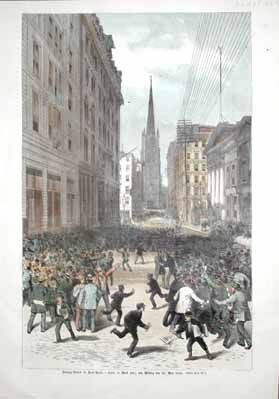
and here. And another... Baaaaaaaaaaaaad, right? Probably more than we, the common folk, know, which leaves me feeling pretty shaky.
I'm not shaky because of the stock markets diving, per se, thought their volatility is certainly worrying. It's when people like the chair of George Mason's Economics department have things like this to say. It doesn't seem irrational to think that kind of watershed moment could come our way, which leaves me with a "and then what?"-type of feeling in my stomach. From Forbes:
The difference between rates in the overnight lending markets and rates in the longer-term markets, a gap that is widening, suggests banks aren't willing to lend much to each other. That is the type of activity needed to break the logjam in the credit markets....
Meanwhile, the London interbank offered rate, which is the rate at which banks lend to each other, continues to rise. The three-month Libor is at 3.77%, according to UBS, and the difference between that and the overnight rate suggests "interbank lending is broken," said William O'Donnell, the head of U.S. interest rate strategy at UBS. Rather than extend credit for longer than overnight, banks appear to be hoarding cash.
"I hope the Fed has a lot of thumbs, because there is water breaking through the dikes everywhere," O'Donnell said.
I've begun to read more about the The TED spread between the three-month Treasury bill and LIBOR (London interbank offer rate) in recent days. That is a true measure of the problem we're facing. Usually at 1.5 percent or 2 percent, this measure of how expensive it is for banks to borrow money overnight, hit a new plateau around 2.5 percent to 3 percent last August. In the
 last 24 hours it rocketed past 3.5 percent, almost doubling to 7 percent.
Three years ago, this would have seemed very pie-in-the-sky, but after seeing the way ripples run through supply chains in industry, whether it's coal or groceries or mail or what-have-you, the financial meltdown seems much more dangerous. Their supply chain is one of money, and what happens if the money that can't be traded between banks all of a sudden translates to money not being lent to you and me through credit cards or mortgages or student loans. What if businesses that rely on loans to float payrolls or emergency capital improvements, can't get access to that money. The Wall Street Journal floats the possibility in a story yesterday. It gets back to what Tyler Cowen of George Mason mentioned in his blog post.
That's when things get really scary. I mean, really terrifying. Good news doesn't seem to trickle down all that often but bad news cascades. I truly believe that. From the L.A. Times:
"We're entering a new phase of the crisis," said Chris Rupkey, chief financial economist with the Bank of Tokyo-Mitsubishi in New York. "If you don't stop the domino effect, you're going to see one institution after another after another going down," he predicted.
That's something the United States last experienced in the early 1930s, when Herbert Hoover was in the White House. Some
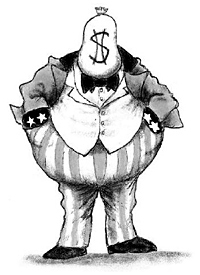 conservatives believe that's still the best long-term solution to the problem, though none has gone so far as Hoover's Treasury secretary, Andrew Mellon, who said: "Liquidate labor, liquidate stocks, liquidate the farmers, liquidate real estate. . . . It will purge the rottenness out of the system."
But House members and their supporters who insisted Monday that the government had no business staging a massive intervention in the financial marketplace were essentially making a modern-day argument for the laissez-faire economic policies of the Mellon era.
So what's to be done? Senate leaders are are promising to press on with the current bailout package. Meanwhile, in some late-night and early morning discussions on the matter, my friend Paul Johnson (who happens to hold a PhD in economics and follows the market religiously, see his book here) presented his idea of what should be done:
First he tried to explain to me why we're seeing what we're seeing: "The reason Bank A doesn't trust Bank B's balance sheet is
 because Bank A knows its own balance sheet is crap... The solution is transparency. Shine light into the dark corners ... Yes it's going to be painful but the pain is here."
His "balance sheet is crap" theory is reiterated by Lawrence J. White, a much more decorated professor at NYU:
So what's the bad news?
Recall that JPMorgan Chase absorbed $240 billion in nominal assets and $188 billion in deposit liabilities, plus some unstated value for the branch network. The net value of this package should be somewhere north of $52 billion. But JPMorgan Chase paid the FDIC only $1.9 billion--and this was the best bid that the FDIC received!
As had been feared, WaMu really did hold a slew of poorly performing mortgages whose nominal value greatly exceeded their market value. Yet WaMu had a reputation (until recently) of being a well-run organization that didn't undertake excessively risky activities or engage in abusive lending practices.
If WaMu's mortgage assets are poorly performing and overvalued, this is strong reinforcement for the view that lots of other financial institutions' mortgages and mortgage-backed securities are also overvalued. Although WaMu's resolution shows that the banking system can handle the problems and that insured depositors need not fret (or run), much--probably most--of these mortgages and MBS's are held outside of the banking system: in investment banking firms, finance companies, insurance companies, hedge funds, mutual funds, pension funds, etc.
In some cases, the recognition of the losses will reduce the value of the fund. Pension claimants will be worse off and mutual fund holders will be less wealthy. But for other non-depository institutions, the losses may lead to bankruptcies and the resolution processes will not be smooth.
From there, Mr. (I guess technically it's Dr., but we'll go with my vernacular) Johnston is advocating for is that instead of the U.S. Treasury incrementally taking on the assets of banks that are in trouble, that the SEC or FDIC, Comptroller, or some regulatory agency within the administrative branch should demand that banks open their books to the public and the government and each other in the way they would a potential buyer. Due diligence, essentially, is the key, he argues. From there the extent of worthless assets beyond what have already been acknowledged (Bloomberg reports $586 billion in write downs over the last year) will be available to everyone. I know honesty and openness isn't a popular concept in Washington or Wall Street or anywhere these days, but in this case it could keep us all from being Jim Morrison a la "I wanna have my kicks before the whole shit-house goes up in flames..."
Then, when those books are open, Mr. Johnston suggests that instead of buying assets, that the government get actual stock
 in the company. Not warrants for future stock purchase, but actual shares. This punishes the shareholders, i.e. the owners, of the companies by diluting the value of each stock certificate, punitive treatment for allowing CEOs to get away this garbage in the first place. Secondly, it gives the banks badly needed capital with which they can help dig themselves out of the hole they're in, and third, it gives the government a much more realistic chance of recouping its outlay if and when individual companies begin to turn a profit again. Quasi-nationalization. For a libertarian and to-the-bone market guy like Mr. Johnston, that says a lot.
This approach makes a certain amount of sense to me, too, because it really does let the market do the work rather than the government. The government hasn't done anything particularly right up to this point and I can't think of an industry that has asked for more regulation recently. If so, the Bush Administration certainly hasn't obliged. Our entire economy, hell, the entire world is leveraged on debt to a point where the only way to go is down. We've hit the top of the mountain and are sliding back to where we were. It could be a disaster, but it will also make people live more responsibly, one would hope.
Ugh. I've got to stop reading all this stuff. It's making me neurotic. For the first time in months, presidential politics actually seems appealing, especially with SNL being funny again! After a downer blog post, enjoy the following:
posted by Pedro_in_Wyoming at 6:39 AM


0 Comments:
Post a Comment
<< Home